



 E-mail Alerts
The Annual Report on the Eco-system of Science and Technology Finance in Shanghai(2024) Released at 2025 Pujiang Innovation Forum
2026-01-15
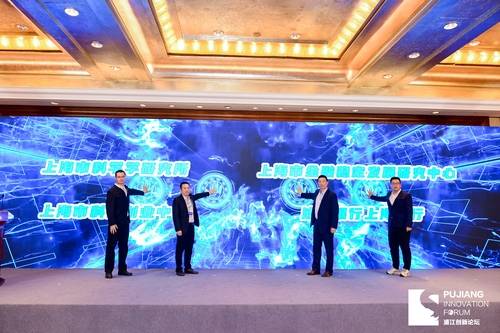
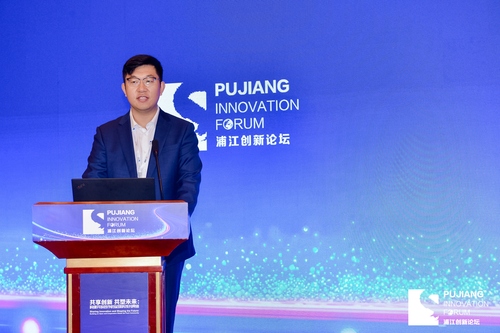
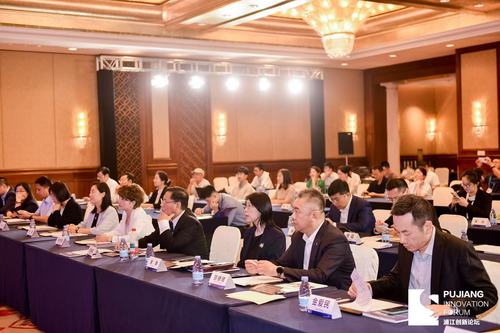
On the afternoon of September 22, the 2025 Pujiang Innovation Forum Achievement Release Conference was held at the Dongjiao State Guest Hotel, with Zhu Xueyan, Deputy Director of our Institute, in attendance. At the conference, the launch ceremony for The Annual Report on the Shanghai Sci-Tech Finance Ecosystem (2024) was jointly initiated by Zhu Bin, Deputy General Manager of the Sci-Tech Finance Department at Shanghai Pudong Development Bank (SPDB) Shanghai Branch; Jin Aimin, Research Fellow at the Shanghai Institute for Science of Science (SISS); Shang Jin, Economist at the Shanghai Financial Stability and Development Research Center; and Yang Chao, Engineer at the Shanghai Technology Innovation Center (STIC). Dr. Xue Chujiang from the Technology Entrepreneurship Research Office of our Institute delivered a detailed interpretation of the report on behalf of the research team.
Comprising four sections and ten chapters, the report covers the ecosystem overview, development, insights, and cases, supplemented by a timeline of key events and a compilation of policies, presenting a comprehensive picture of Shanghai's sci-tech finance ecosystem in 2024. The report tracks and analyzes changes in the ecosystem across multiple dimensions, including sci-tech credit, sci-tech insurance, equity investment, and the multi-level capital market. It also offers perspectives centering on institutional innovation and shares practical cases, aiming to provide a reference for the industry and support for decision-making.
The report shows that the Shanghai Sci-Tech Finance Ecosystem Index maintained an overall stable trend from 2019 to 2024, with both the index and its growth rate in 2024 experiencing a slight decline compared to 2023. By 2024, the outstanding balance of loans to technology enterprises in Shanghai had reached nearly 1.3 trillion yuan. A series of policy-oriented credit products, such as the Sci-Tech Performance Guarantee Loan launched by STIC, had cumulatively disbursed 6.668 billion yuan. In terms of sci-tech insurance, relevant policy documents and product catalogs have been successively issued, and the development of the Sci-Tech Insurance Innovation Leading Zone in the Lingang New Area has steadily advanced. Regarding equity investment, while the number and scale of investments in Shanghai decreased year-on-year in 2024, the scale still ranked second nationwide, trailing only Beijing. Direct financing delivered a remarkable performance: 18 Shanghai-based enterprises were listed domestically and overseas throughout the year. Over half were deep tech enterprises, including four listed on the STAR Market, accounting for 22.2%. This underscores the capital market's strong support for scientific and technological innovation.
 沪ICP备
11048235号-2
沪ICP备
11048235号-2
All copyright © Shanghai Institute for Science of Science
Address:4-5 F, 1634 Middle Huaihai Road, Xuhui District, Shanghai
Telephone:(021) 53300888 Fax:(021) 64381056 Email:siss@siss.sh.cn Zip code:200031
 沪公网安备 31010402001155号